Print it
Housing
- Printed shroud, matte black
- Fits the 8-LED stick, 6.64 mm pitch
$19
Add
CAN bus shift light · MINI Cooper S R53 · 2002–06
Eight LEDs on the column shroud, dead centre in your sightline, fed by the engine's own CAN bus. No tach signal to run, no phone required. Three seconds after the RPM frames stop, it goes dark instead of lying.
CAN 0x316 · bytes 2–3 · ÷ 6.4 · 100 frames/s
start 3500 · colour shift 6000 · redline 7100 · blink 200 ms

01 · The housing
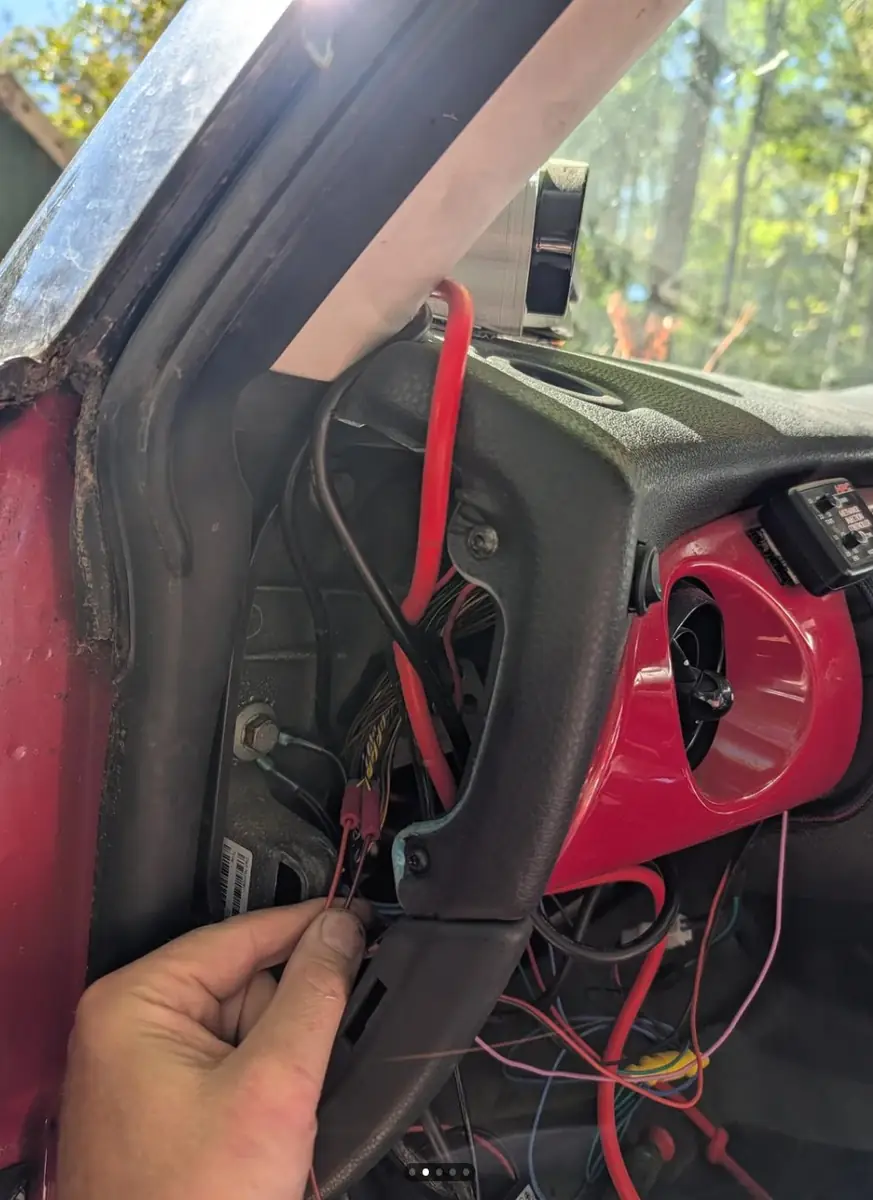
Directly under the tach pod, so the flashing bar and the needle land in the same glance. The shroud shades the LEDs enough to kill windscreen reflections, and because it rides on the column, the wheel rim never blocks it.
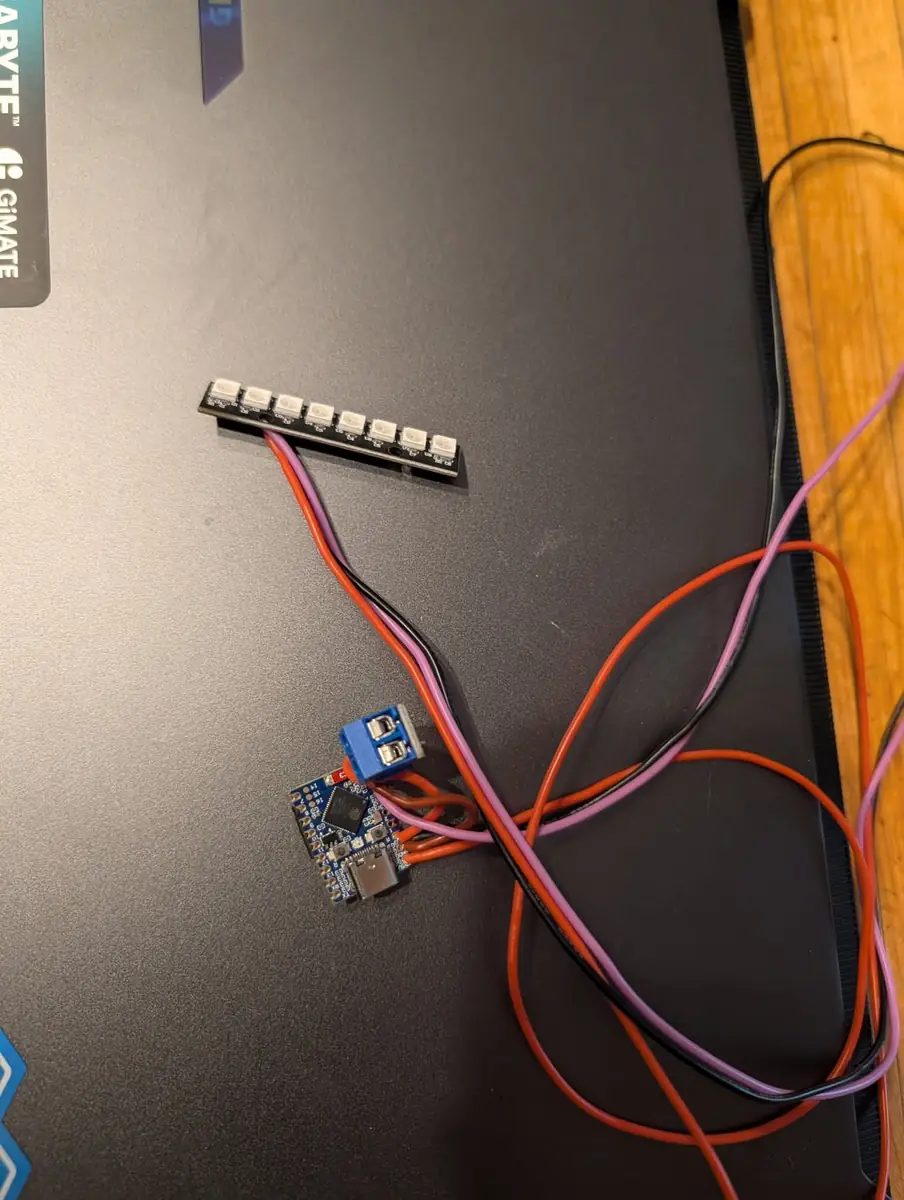
02 · The shift light, assembled
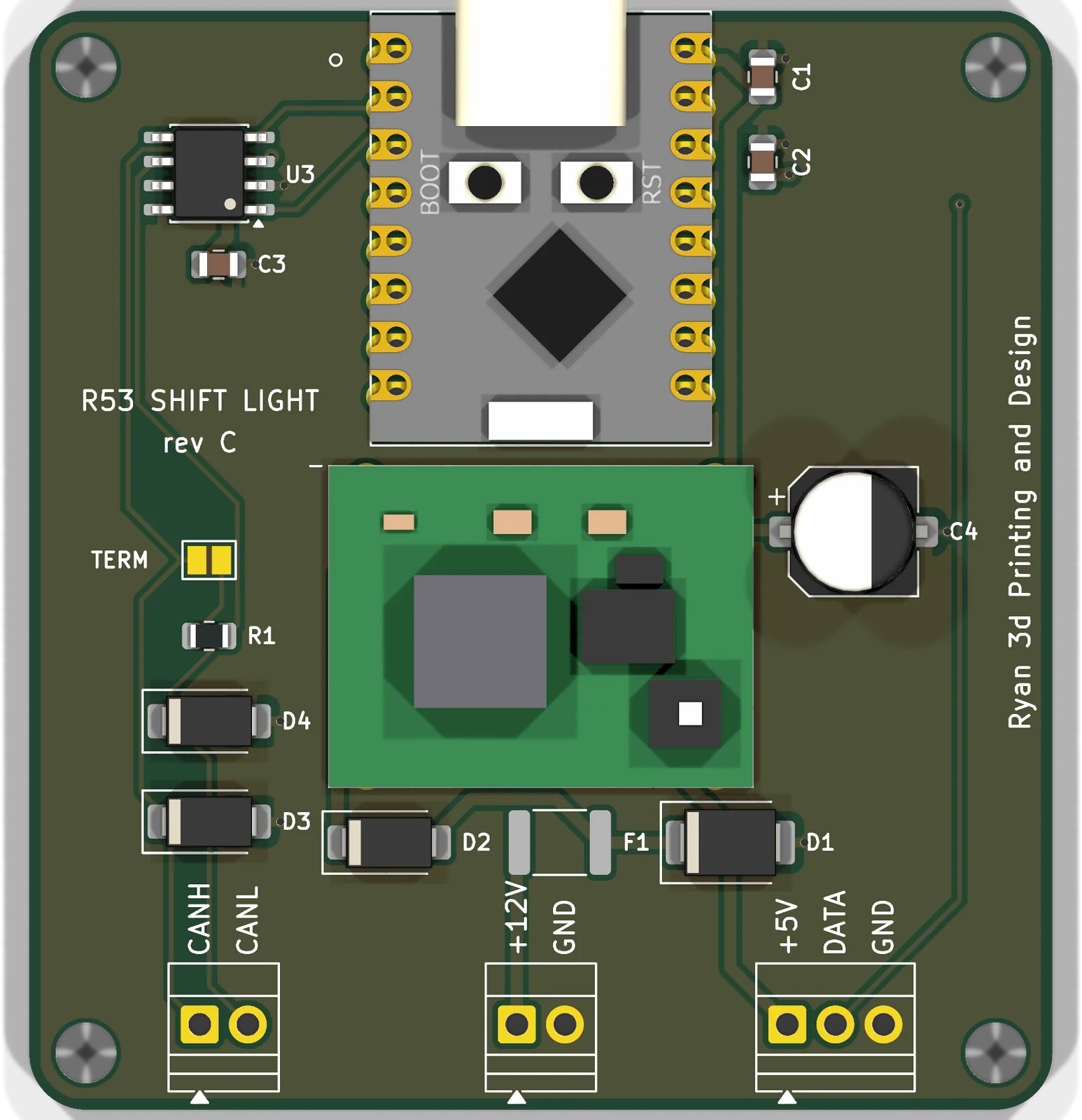
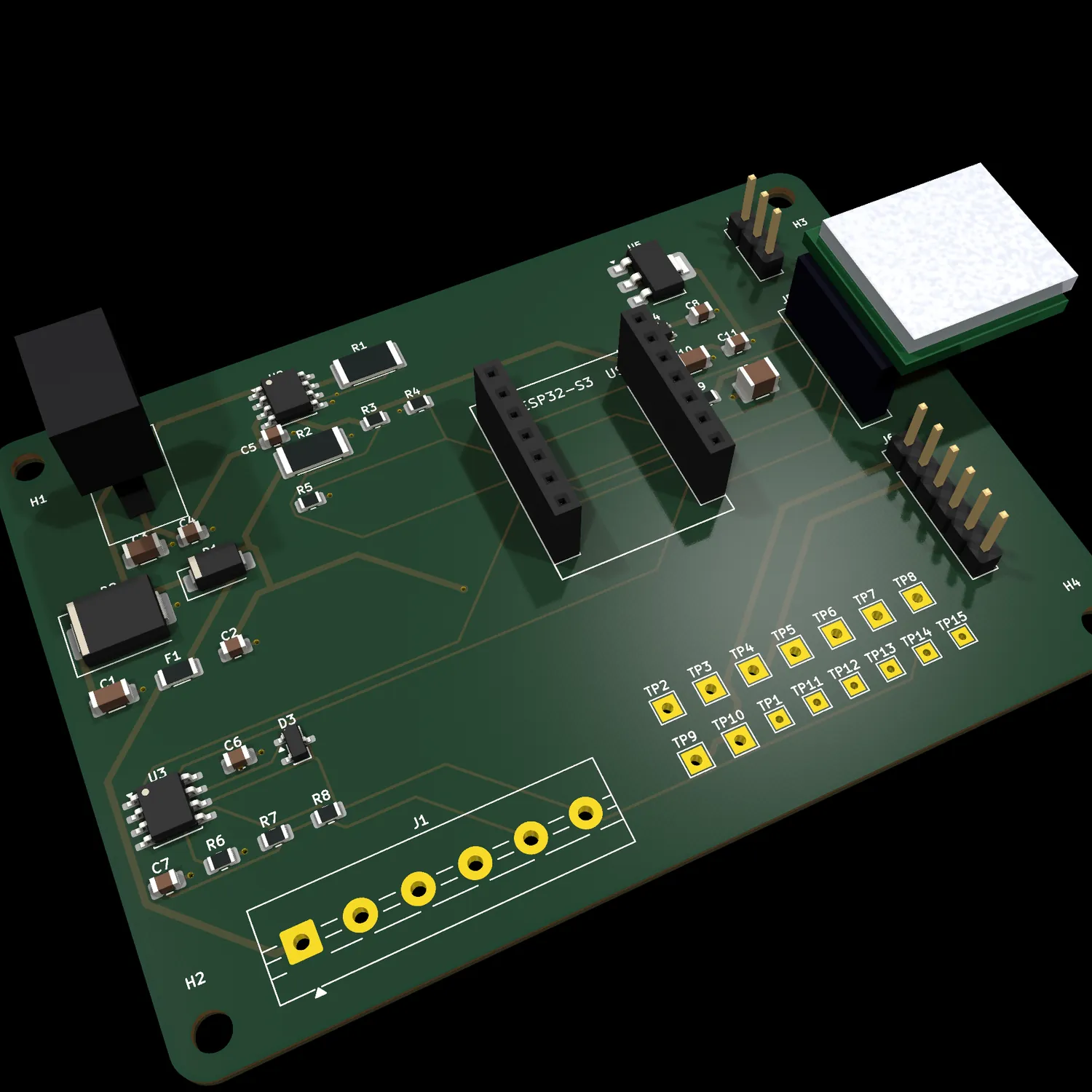
The carrier replaces a dev board, a CAN breakout, a USB buck module and the harness between them, every joint of which is a thing that vibrates loose in a car. Twelve volts in on a screw terminal; the strip and the bus on two more.
 Carrier · rev A · 54 × 48 mm · 4 layer
Drag to turn · scroll to zoom
Carrier · rev A · 54 × 48 mm · 4 layer
Drag to turn · scroll to zoom
Every terminal pin is labelled above the pin it belongs to. You wire one of these upside down under a dash with a torch in your teeth.
03 · The companion app · free
The strip along the top of the screen is the real one, mirrored at 10 Hz from live RPM. Drag the redline down to 6,800 and the bar fills sooner, right there, before you have moved the car. Nothing on the Bluetooth side sits between the CAN bus and the LEDs.
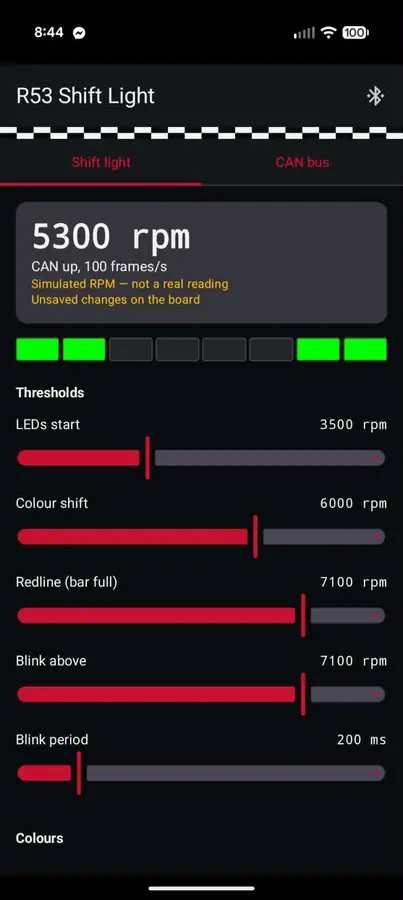
Thresholds · live mimic
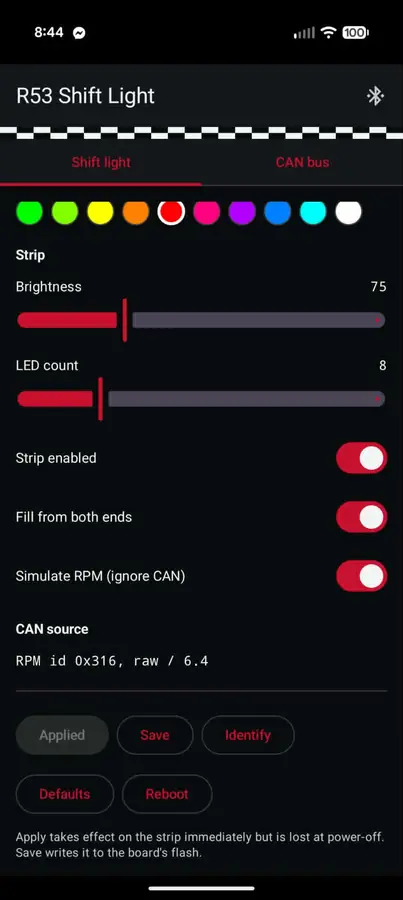
Colours · fill · brightness
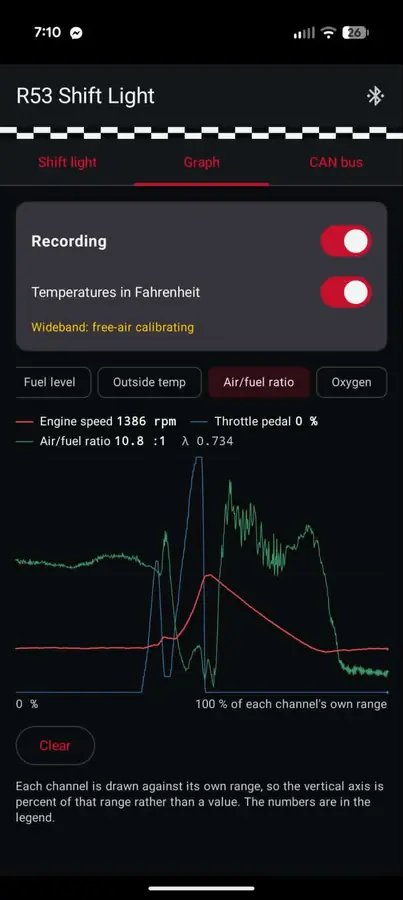
Graph · RPM off the bus
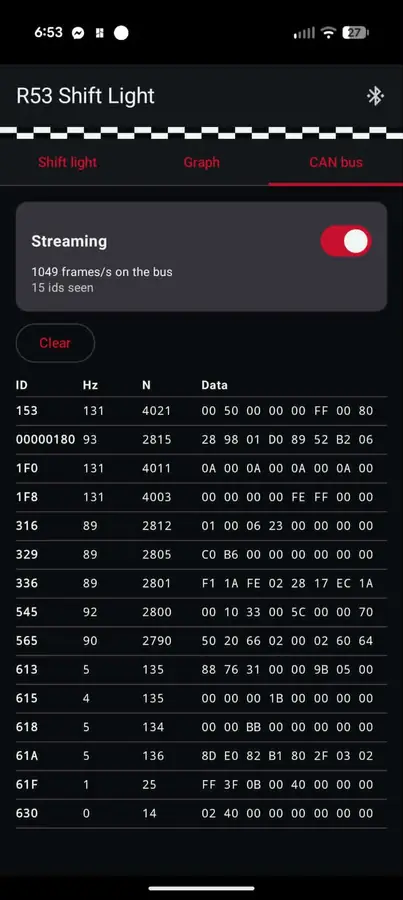
CAN monitor · every id
Writes to RAM. The strip changes now; the change is gone at the next power cycle. Dragging a slider does not burn a flash write per frame.
Commits what the board is running to flash. The board reports when the two differ, including first boot on a blank board, so your first edit is never lost.
 Scan for
iPhone: Safari has never shipped Web Bluetooth, so the app runs in Bluefy, a free browser that bridges it. Same board, same screens, nothing to install from the App Store.
04 · For those who want more · R53 Logger · Flasher
An Android app that pulls engine telemetry straight from ECU RAM over K-line, fuses it with wideband AFR from the bridge into one time-aligned log, and then writes the calibration changes you decide on back to the EMS2000. Three one-time unlocks on Google Play: the app, the tune options, and the factory software.
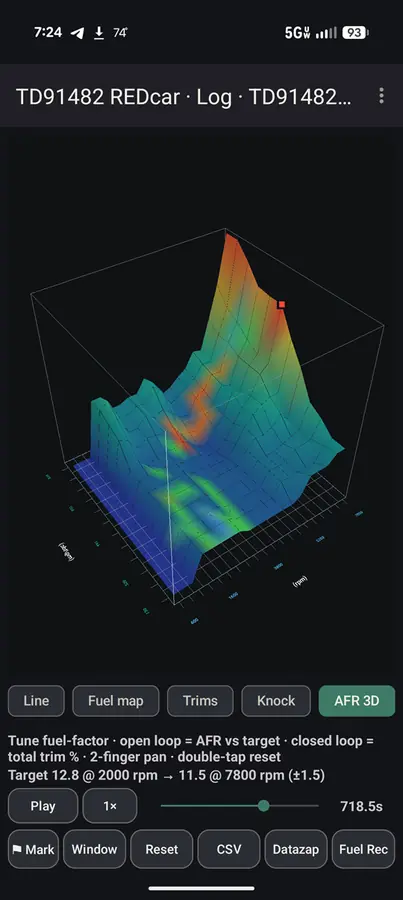
AFR surface · rpm × load
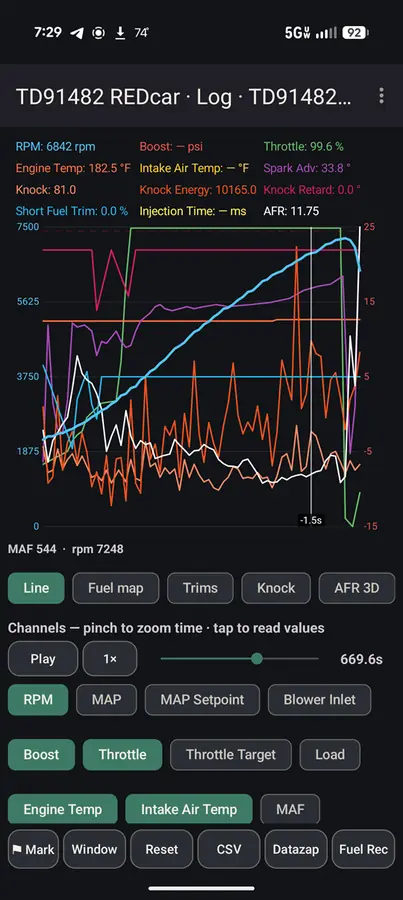
Live graph · a pull
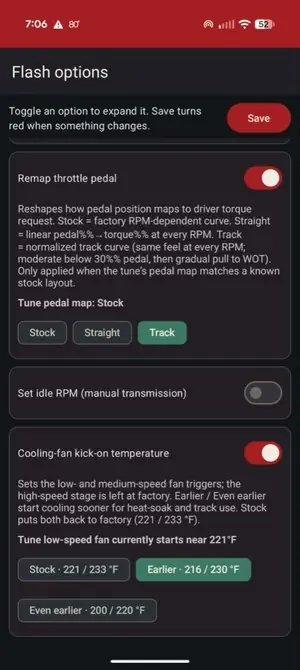
Flash options · pedal · fan
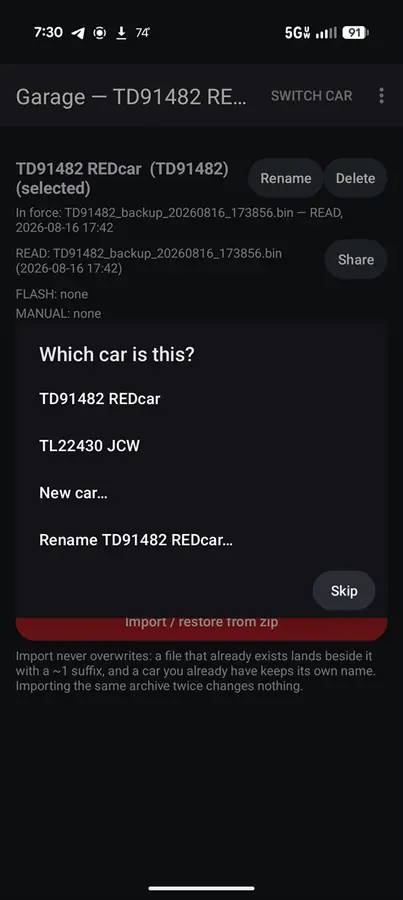
Garage · per-car bins and logs
Logging, diagnostics and the 512 KB ECU backup read. Live graph, DTCs with cause and fix, autolog on wide-open throttle, AFR surface, fuel, trims and knock maps, CSV and Datazap export.
The tune options: pops, injector size, redline, pedal map, idle RPM, cooling-fan kick-on. Checksum recomputed before every write.
Bundled US S, JCW and GP1 images as flash bases. Put a car back to stock, or start a tune from a different factory map.
ECU write needs the App unlock plus either add-on. Flash write needs the facelift silver-cover ECU; logging works on the other boxes. Reads and writes are done key on, engine off, on a battery charger.
 $25app unlock
$50flash unlock
$50factory software
Works with a K+DCAN USB cable and USB-C OTG. Works better with the bridge: wideband AFR, CAN channels and the shift light in one log.
$25app unlock
$50flash unlock
$50factory software
Works with a K+DCAN USB cable and USB-C OTG. Works better with the bridge: wideband AFR, CAN channels and the shift light in one log.
Off-road and competition use. An ECU flash can brick a car; the app backs up the stock BIN first and refuses to write on a shared wire. R53 Coding, the module-coding companion, is a separate app with its own unlock.
05 · Top of the range · K-line + CAN bridge
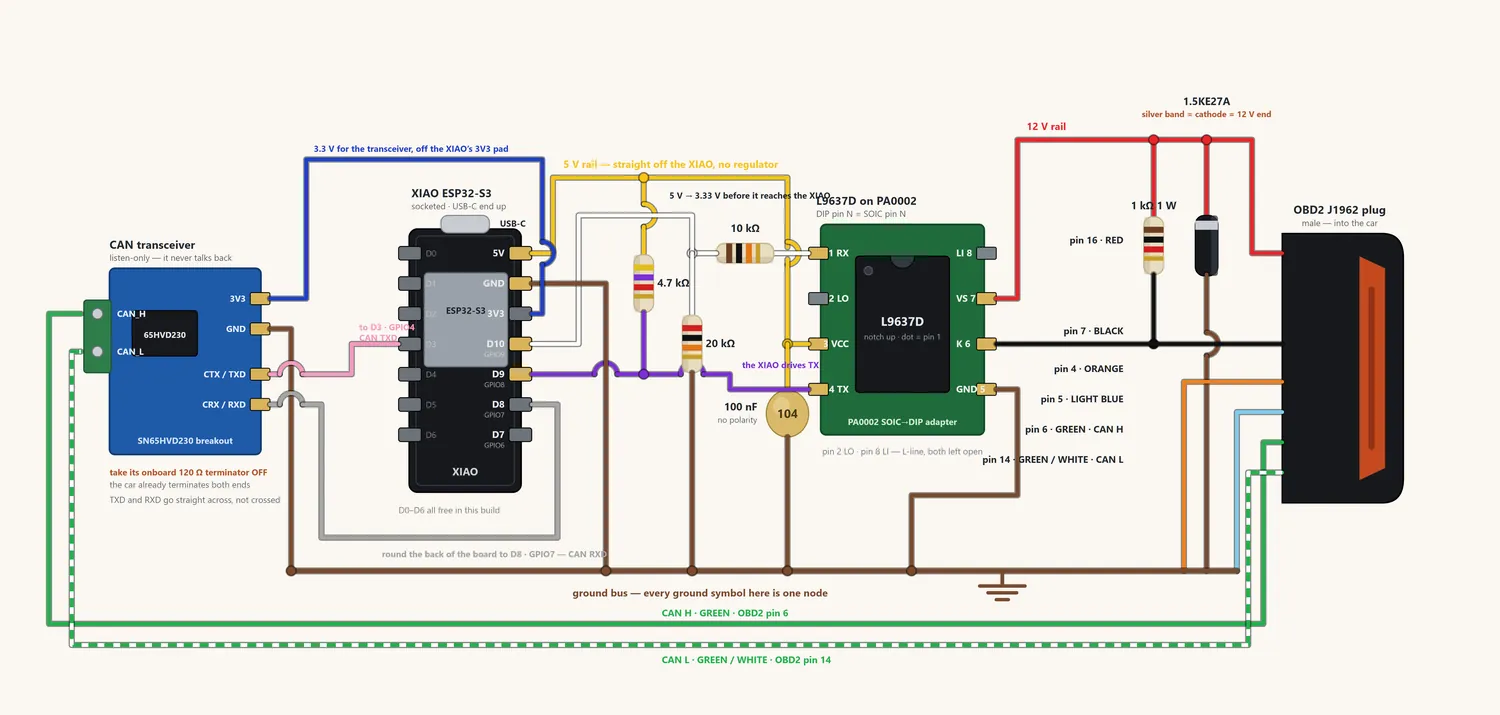
One board in the footwell that reads the Siemens EMS2000 over K-line, listens to the CAN bus, and drives the shift light. It plugs into the OBD2 socket and ships raw ECU blocks to your phone over Bluetooth, where the logger does the decoding. It is the best input the logger can have: wideband, CAN channels and the shift light, all in the same time-aligned log.
| OBD2 pin | Wire | Signal |
|---|---|---|
| 4 | orange | chassis ground |
| 5 | light blue | signal ground |
| 6 | green | CAN H |
| 7 | black | K-line |
| 14 | green / white | CAN L |
| 16 | red | battery +12 V |
Order
The housing fits the assembled light. The logger runs on a K+DCAN cable and runs best on the bridge, which includes the light. The bridge is the top of the range.
Shift light $125 and the three logger unlocks ($25 app, $50 flash, $50 factory software) are confirmed. Housing and bridge prices are placeholders. Shipping and lead time to be confirmed.
Fitment
First-generation MINI Cooper S, chassis R53, the supercharged one. Siemens EMS2000 ECU.
The CAN id the RPM rides on. The id and the divisor are settings, so a different car is a config change, not a rebuild.
OBD2 pins the bridge uses. CAN is run to pins 6 and 14 so the socket is the single service point.
Yes. The strip runs from CAN with no phone and no app. The app only configures and observes. Thresholds saved to the board survive power-off.
No. The node is configured listen-only and never drives a dominant bit, so it cannot acknowledge or disturb the bus. The 120 Ω termination jumper ships open because a vehicle bus is already terminated at both ends.
Because Safari has never had Web Bluetooth and every iOS browser has to use Safari's engine. Bluefy bridges it. The web app is the same three screens as Android and is free.
It is a flash tool for a twenty-year-old ECU, so treat it that way. The app reads and backs up the stock BIN before any write, recomputes the checksum, and refuses to write if anything else is on the K-line. Off-road and competition use only.
Not AWS Route 53. R53 is the chassis code.